
Every tenancy document a UK landlord needs
Professionally drafted. Always compliant. Zero effort.
DocuTenant is a document engine for UK private landlords who manage their own properties. It covers all 47 documents in a UK tenancy and generates 38 of them for you — agreements, notices, deposit forms, inventories and inspection records — for both England and Scotland, as PDF or Word files, from one property record. The other nine are the certificates you get from a professional, and it tracks their expiry dates.
An animation: a document page rewrites itself as the document type or property changes, drafting a rent increase and a possession notice to English or Scottish law and carrying the tenant, address and rent across.
Built on current law, kept current
- Renters' Rights Act 2025
- Housing Act 1988
- Private Housing (Tenancies) (Scotland) Act 2016
- Renting Homes (Wales) Act 2022
Every document across the tenancy lifecycle
47 documents covering 7 phases — from your first listing to final checkout.
Browse template previews
Phase 1 · 9 docs
Before Letting
Setup & compliance
Smoke & CO statement, legionella risk assessment

Phase 2 · 6 docs
Finding Tenants
Marketing & screening
Property listing, tenant application, reference request

Phase 3 · 8 docs
Starting the Tenancy
Agreements & move-in
Tenancy agreement, deposit prescribed info, inventory

Phase 4 · 10 docs
During the Tenancy
Ongoing management
Inspection notification, rent increase notice, arrears letters

Phase 5 · 6 docs
Ending the Tenancy
Notices & possession
Section 8 notice, deposit deductions, checkout report

Phase 6 · 3 docs
Financial & Tax
Records & reporting
Rent statement, income & expense summary, mileage log

Phase 7 · 4 docs
Between Tenancies
Turnover & re-let
Turnover checklist, contractor quotes, updated listing
Built on current law, kept current
Compliance you can check, not take on trust
Every document maps to a piece of named legislation. No generic templates, no out-of-date forms, no “works in most cases” hedging.
Renters’ Rights Act 2025 ready
Every England document is already updated for the law that took effect on 1 May 2026: Section 8 with all 37 grounds, AST as periodic with Section 48 inline, rent increase via Form 4A, updated arrears thresholds, pet consent under Section 16A, and the rental bidding ban.
Two jurisdictions, correctly separated
Scotland — Private Housing (Tenancies) (Scotland) Act 2016 (PRT). England — Housing Act 1988 as amended by the RRA 2025 (AST). You only see documents that apply to your property's jurisdiction. Wales (Renting Homes (Wales) Act 2022) — coming.
Versioned and kept current
Each template carries a version stamp. When the law moves, the template moves, and you regenerate from the latest version with the data you already have — no rewriting, no re-keying.
47 documents across the full lifecycle
From pre-letting compliance through finding tenants, starting the tenancy, ongoing management, ending tenancies, financial records, and turnover between tenancies. Seven phases, all covered — not just the headline ones.
- documents
- 47
- phases
- 7
- Section 8 grounds
- 37
Three steps. That’s it.
- 1
Add your property
Enter your property details and tenancy information once.
- 2
Choose a document
Browse the document library and select what you need.
- 3
Download instantly
Review the live preview and download as PDF or DOCX.
Previewing is always free
Browse template previews
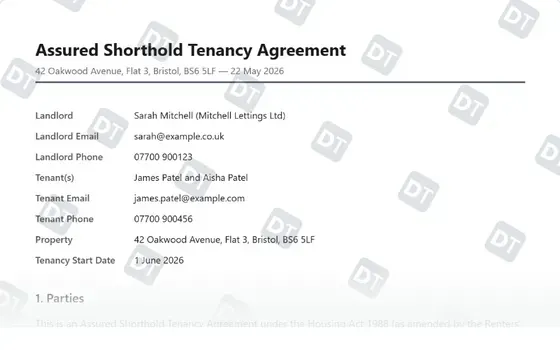
England
AST Tenancy Agreement Template
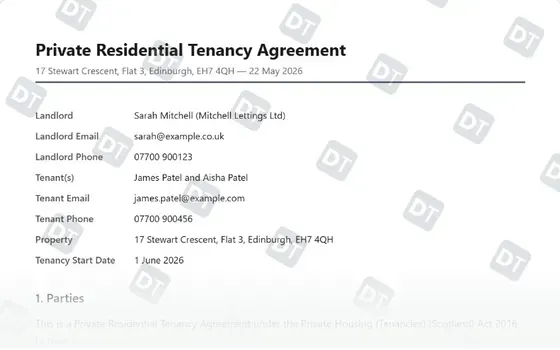
Scotland
Private Residential Tenancy (PRT) Agreement Template
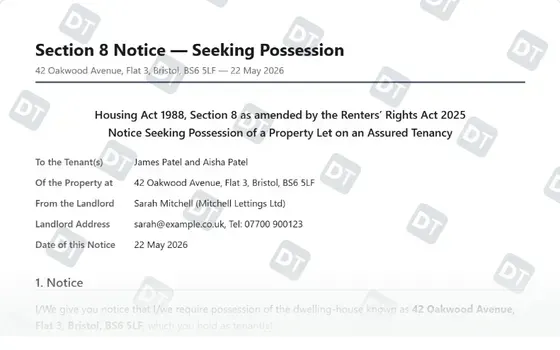
England
Section 8 Notice Template (Form 3A)
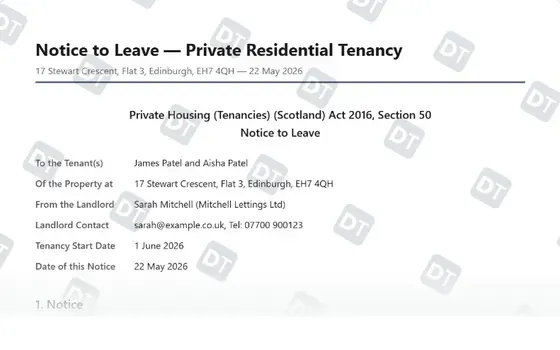
Scotland
Notice to Leave
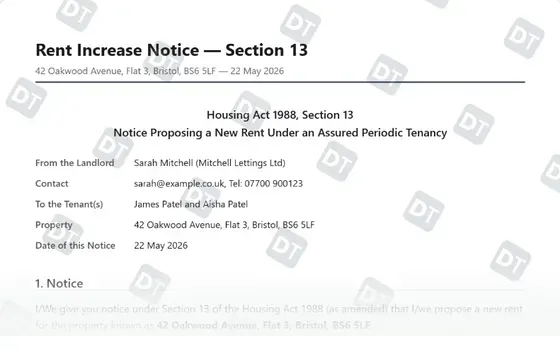
England
Form 4A Rent Increase Notice Template
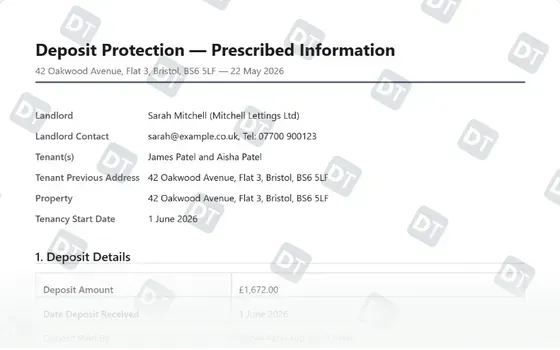
England & Scotland
Deposit Prescribed Information Template
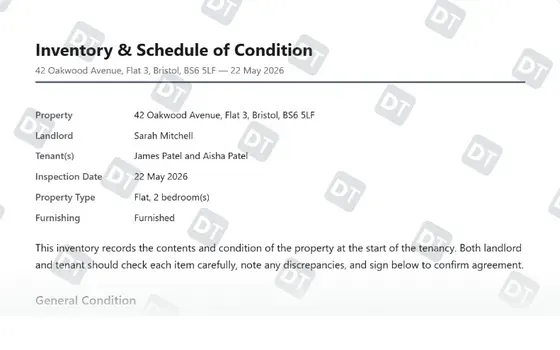
England & Scotland
Landlord Inventory and Schedule of Condition Template
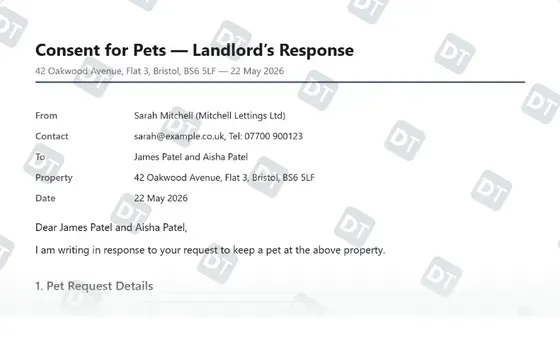
England
Pet Consent Letter
Everything you need to manage tenancy documents
From pre-tenancy setup through to end-of-tenancy — every document, always compliant.
- 1
Scotland and England, correctly
PRT or AST. You only see the documents and law that apply to that property.
- 2
Your details, always remembered
Add a property once. Names, address, rent and deposit fill themselves in.
- 3
AI-powered where it matters
Listings, welcome packs and inspection reports written for your property.
- 4
47 professionally drafted documents
Tenancy agreements, Section 8 notices, deposit forms, arrears letters and more.
- 5
Certificate dates on the property
EPC, gas safety and EICR dates kept beside that property’s paperwork.
- 6
PDF and DOCX export
Download a clean PDF, or a Word file you can edit and send.
Simple, transparent pricing
Preview free, pay when you download.
Single document
For one tenancy, one document
£9one-off
Previewing is always free
- Any of the 40 template documents
- One document, one property, forever
- Regenerate it free, always
- PDF and DOCX download
- Unlimited previews
Pro
RecommendedFor serious landlords
£9.99/month
or £89/year (3 months free)
- Unlimited properties
- All 40 template documents
- AI-powered documents
- Unlimited previews
- Unlimited downloads
- Your own logo on every document
Landlord guides
See allScotland: Private Residential Tenancies
Awaab's Law in Scotland: The Damp and Mould Rules for Private Landlords from 6 October 2026
From 6 October 2026, Scottish private landlords have fixed deadlines for damp and mould: investigate within 10 working days, report to the tenant within 3, and start work within 5. Here is how the clock works and what the written summary must say.
Scotland: Private Residential Tenancies
Scotland from 6 October 2026: Bigger Wrongful Termination Awards and a Shorter Succession Rule
Two Housing (Scotland) Act 2025 changes start on 6 October 2026. A landlord who misleads a tenant into leaving can now be ordered to pay up to 36 times the monthly rent (or £840, if higher), and people living with a tenant who dies can take over the tenancy after six months instead of twelve.
Scotland: Private Residential Tenancies
Scotland's New Notice to Leave and Rent-Increase Forms: What Changes on 1 April 2027
The Scottish Government has made new prescribed forms for private residential tenancies, in force from 1 April 2027. The Notice to Leave moves to schedule 4, tenants get 30 days to challenge a rent increase, and one joint tenant will be able to end the tenancy for everyone.
Frequently asked questions
Everything you need to know before getting started.
What documents do landlords need in 2026?
What changed with the Renters' Rights Act in May 2026?
Are DocuTenant documents legally valid?
How does the AI document generation work?
Which parts of the UK are supported?
How much does DocuTenant cost?
Can I cancel or delete my account at any time?
Sound familiar?
£150–£300 per solicitor letter
Every tenancy agreement, every notice, every time. It adds up fast.
Free templates you can’t trust
Downloaded from a forum in 2019. Wrong jurisdiction. Missing the latest legislation.
Hoping for the best
No inventory means losing deposit disputes. No paper trail means losing in court.
From May 2026, the Renters’ Rights Act makes getting this wrong even more costly. Section 21 is gone. Every eviction now needs proper documentation.